- 0493 435 838
- enquiries@websitedesignsagency.com.au
- 2/29 Princes Hwy Service Road Dandenong, VIC 3175
WCAG 2.1 accessibility design for registered and non-registered NDIS providers. We build accessible disability provider websites that support participants using assistive technologies, meet recognised accessibility standards, and align with NDIS Quality and Safeguards Commission expectations.
Accessible navigation and heading structure — so screen readers and keyboard users can move through your website without barriers
WCAG 2.1 colour contrast, form labelling, and mobile responsiveness — applied from the first wireframe, not added after launch
Structured content that helps participants, families, and support coordinators find your services and make contact without confusion

Accessibility principles applied to every disability provider website we build
Navigation, headings, and forms structured for assistive technology users
NDIS accessibility design for providers in every state and territory
Easy to manage and update as your services grow
Weeks to implement accessibility improvements — audit to live changes
NDIS focused — every website we build is designed specifically for the disability support sector
States covered — registered and non-registered NDIS providers across Australia
The accessibility standard we apply to every disability provider website
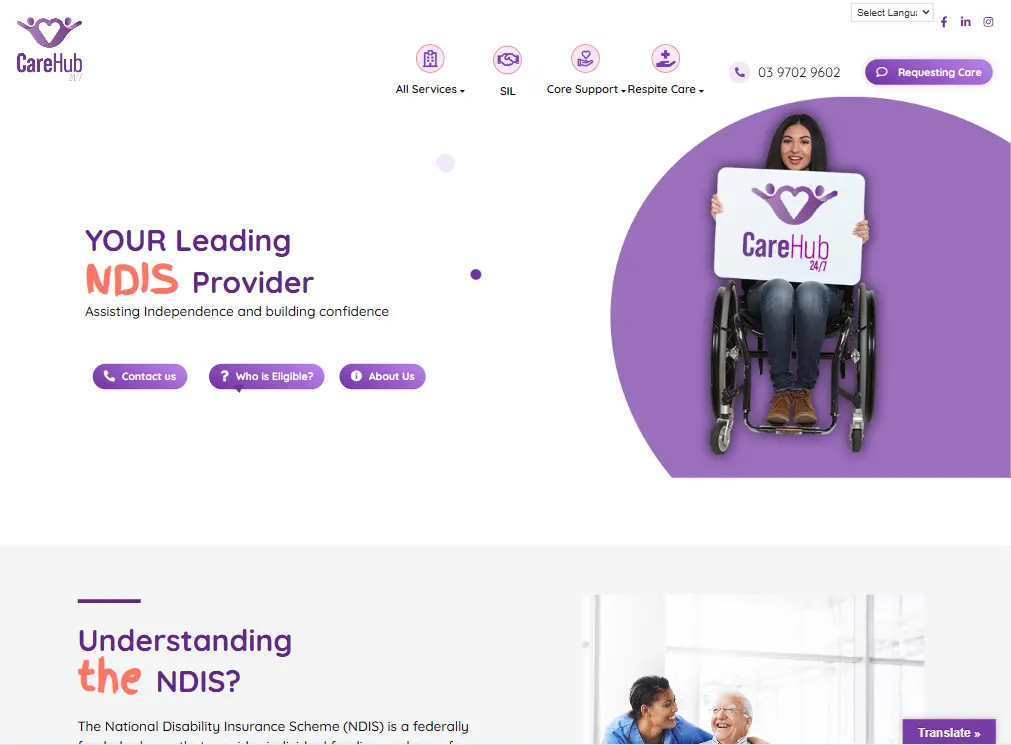
Care Hub 24/7 required a structured, participant-focused website with accessible navigation, clear service categories, and local search visibility across Melbourne suburbs. The project included a full accessibility review and WCAG 2.1 implementation across navigation, forms, and content structure.
“A strong, structured platform that clearly communicates our services to participants and families.”
— Care Hub 24/7

Many NDIS participants access websites using screen readers, keyboard navigation, and voice tools. An inaccessible website does not just create a poor experience — it excludes the people your organisation exists to support. For disability support providers, accessibility is not a nice-to-have feature. It is a baseline expectation that shapes participant trust before a single enquiry is made.
A properly implemented accessible NDIS website ensures that participants with visual, motor, and cognitive disabilities can navigate your services, understand your support categories, and make contact without barriers. It also strengthens your organisation’s credibility with support coordinators who evaluate providers on behalf of participants.
WCAG 2.1 accessibility applied from the first wireframe — not retrofitted after launch
Screen reader compatibility, keyboard navigation, and colour contrast validated before launch
Accessible form design so participants and support coordinators can submit enquiries without technical barriers
Heading hierarchy and content structure reviewed for assistive technology compatibility
Mobile accessibility tested across devices — not just desktop
Audit reports provided for existing websites with a prioritised improvement plan
Our NDIS website accessibility design service covers new builds, existing website audits, and structured improvement plans. Whether you are launching a new provider website or improving an existing platform, accessibility is embedded into the process — not applied as a final checklist.

We evaluate your existing website against WCAG 2.1 accessibility guidelines and identify usability barriers affecting participants with disabilities. The audit covers colour contrast, navigation structure, screen reader compatibility, keyboard access, form labelling, heading hierarchy, and mobile responsiveness. You receive a structured report with prioritised improvements so your team can act on findings in order of impact.

Following an audit — or as part of a new website build — we implement WCAG 2.1 accessibility principles across your entire platform. This includes colour contrast compliance, accessible navigation landmarks, skip links, focus indicators, alt text for images, and ARIA labelling where required. Every implementation is validated before handover.

Accessible navigation is about more than passing an automated scan. We restructure navigation menus, heading hierarchies, and content flow so that participants using screen readers experience your website in a logical, predictable sequence. Service pages are ordered around how participants and support coordinators actually think — not how your internal team organises information.

Before launch, every website is tested across multiple devices and accessibility tools — including screen reader simulation, keyboard-only navigation testing, and colour contrast validation. We do not rely solely on automated scanners. Manual testing identifies issues that automated tools miss, particularly in complex navigation patterns and dynamic content areas.
Our NDIS website accessibility design process follows recognised Australian and international standards:
The internationally recognised standard for web accessibility, covering perceivable, operable, understandable, and robust design principles
Guidance for accessible digital services in the Australian context
Provider expectations for accessible, participant-friendly digital presence
Key accessibility features and the benefit each delivers for NDIS participants and support coordinators.
| Accessibility Feature | Benefit | Status |
|---|---|---|
| Colour contrast compliance | Supports visually impaired users | ✓ Included |
| Screen reader compatibility | Enables assistive technology | ✓ Included |
| Accessible navigation | Improves usability | ✓ Included |
| Keyboard navigation | Required for WCAG compliance | ✓ Included |
| Accessible forms | Improves enquiry accessibility | ✓ Included |
| Structured headings | Helps screen readers | ✓ Included |
Our NDIS website accessibility design services support providers in every state and territory. Whether you are based in a metropolitan centre or a regional service area, accessibility improvements are delivered remotely and implemented to the same standard nationwide.

Understanding what accessible NDIS websites require involves more than a checklist. These resources cover the compliance, design, and structural considerations every disability provider should understand before building or improving their website.
Providers improving accessibility may also need broader website improvements or visibility support:
NDIS website accessibility design is the process of building or improving disability provider websites so participants using assistive technologies — screen readers, keyboard navigation, voice tools — can access services without barriers. It applies WCAG 2.1 guidelines to navigation, content structure, forms, colour contrast, and mobile responsiveness. For disability support providers, accessibility is a baseline expectation, not an optional feature.
While there is no single legislative mandate specifying a minimum website accessibility standard for NDIS providers, the expectation of accessible, participant-friendly digital platforms is consistent with NDIS Quality and Safeguards Commission guidance. More importantly, many NDIS participants rely on assistive technologies to access online information. An inaccessible website excludes the people your organisation exists to support.
Yes. Accessible websites typically perform better in search because the structural improvements that support assistive technology users — clean heading hierarchy, descriptive link text, fast load speeds, mobile responsiveness — align directly with what Google evaluates for ranking. Accessibility and search performance are complementary, not separate goals.
Most accessibility improvements for an existing NDIS provider website can be implemented within 3–6 weeks following an audit. The timeline depends on the current state of the website, the volume of changes required, and whether the platform supports accessible implementation without a full rebuild. We provide a clear improvement plan and timeline at the end of every audit.
Yes. Our NDIS website accessibility audit reviews your existing platform against WCAG 2.1 guidelines and identifies usability barriers affecting participants with disabilities. You receive a structured report with prioritised findings and a recommended improvement plan. Contact us to arrange an accessibility review of your current provider website.
If your organisation needs an accessibility audit, WCAG 2.1 implementation, or a new disability provider website built to accessible standards, our NDIS website accessibility design team can help. We work with registered and non-registered providers across Australia to build inclusive platforms that support participants, families, and support coordinators without barriers.
We’ll show you exactly where you stand and which channels represent your fastest path to qualified leads.
Partner with Melbourne’s SEO experts for fast, SEO-optimised, brand-true websites that are simple to navigate and built to perform.